Proposed special ability
Pattern Recognition
Once per round, when another friendly Character is attacked, you may pay 1 Faith to give that defender +2 Defense for this combat. Activate before any dice are rolled.
An extraordinary mind for mathematics and complex systems, shaped by years of being misunderstood.
Age 43 · Black woman · Autistic · Exceptional mental calculation and pattern recognition
ARTWORK COMPLETE · ALPHA GAME CARDExplore the real-world topics connected to this character. Evidence and fictional applications are labeled separately.
Explore this character’s Wiki connections Browse the Holy Wars Wiki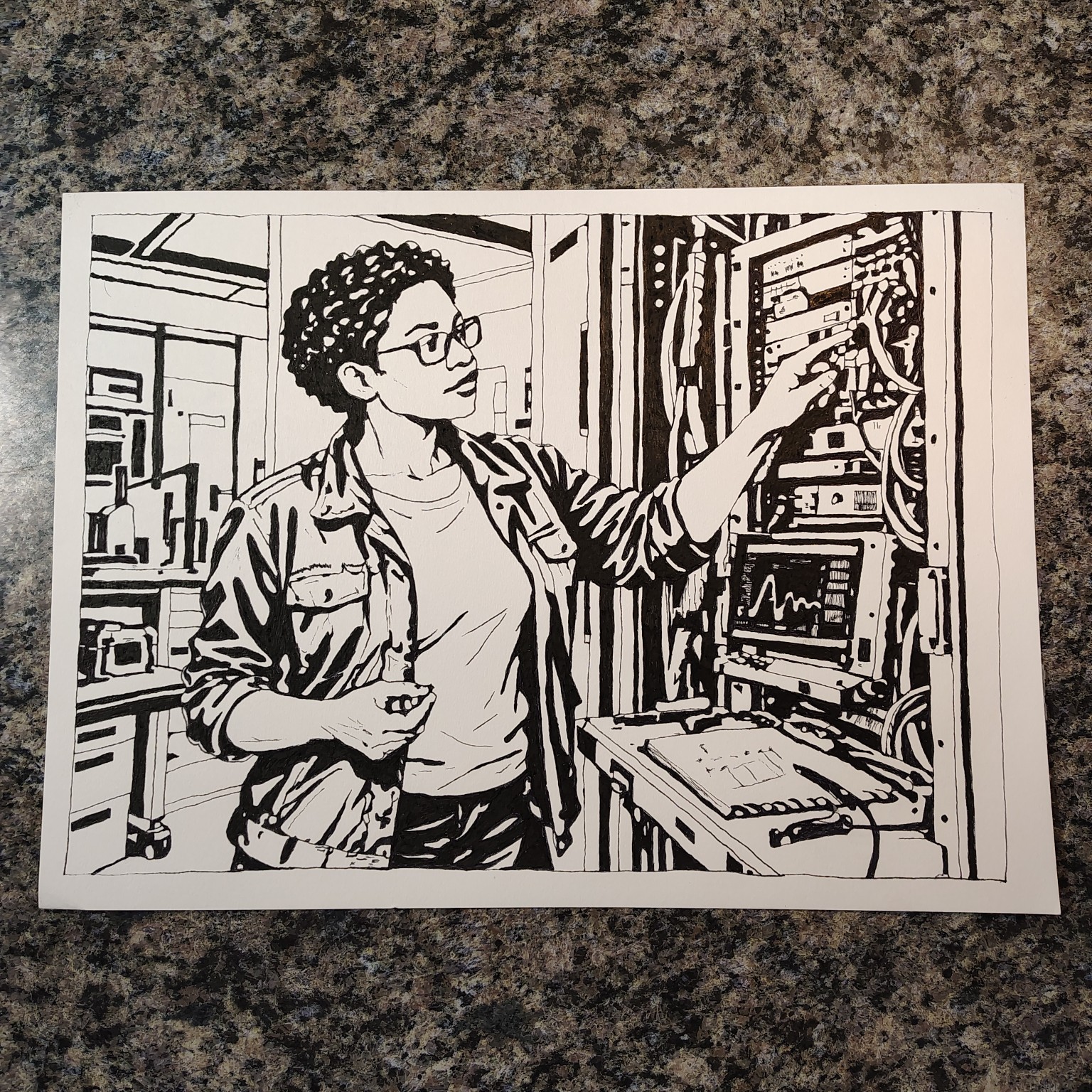
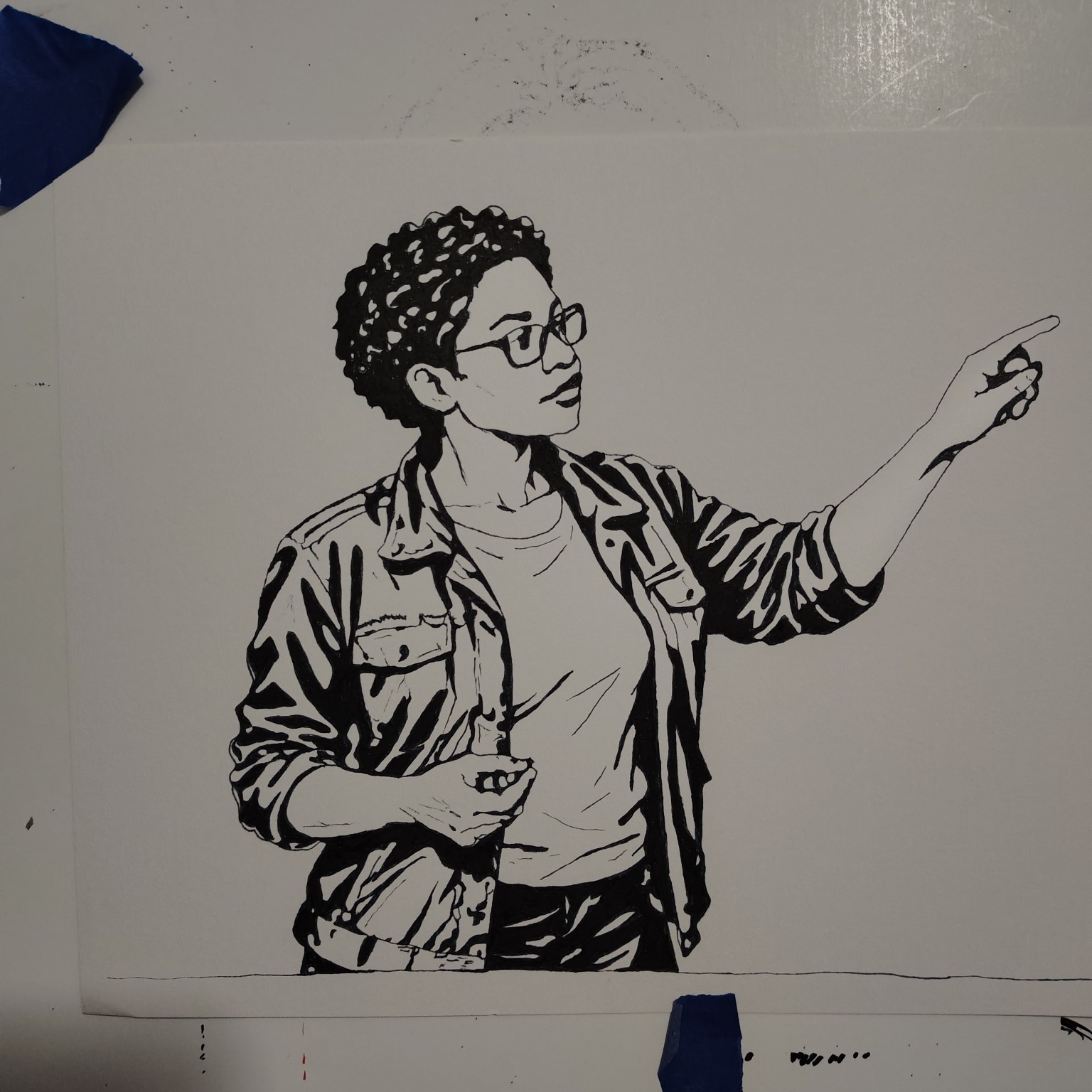
See the drawing from the beginning Play with Naomi’s illustrated card See Naomi’s lifelike reference
Type: Living Character · Identifier: Engineer · Role: Defensive support
Once per round, when another friendly Character is attacked, you may pay 1 Faith to give that defender +2 Defense for this combat. Activate before any dice are rolled.
Naomi recognizes an opponent’s approach and warns an ally. Stats, cost, identifier, and ability are proposals awaiting playtesting. The once-per-round use resets at the start of your turn. The third stat is labeled Faith to match the current character-card format.
Her exceptional calculation and pattern-recognition abilities coexist with substantial social and sensory difficulties. She can recognize manipulation, form close relationships, and care deeply about others. Her scientific curiosity, professional pride, and loyalty are individual parts of her personality.
Her right hand makes a small, silent snapping motion, becoming faster with nervousness or excitement. Its meaning depends on the surrounding context.
Naomi is a fictional autistic individual with savant abilities. Her experiences represent this character; autism does not imply exceptional mathematical talent, and autistic people have varied abilities and support needs.
Long before anyone called Naomi Brooks gifted, adults had other explanations for her silence.
She grew up in a family where money rarely stretched far enough. Her family cared about her, but specialist appointments, transportation, and time away from work were difficult to arrange. They knew that school was hard for her. They did not know why.
In a crowded classroom, Naomi could lose the ability to answer a question she understood. Several voices at once made it difficult to follow any one of them. Being told to hurry made the words harder to find. Some teachers mistook her silence, awkwardness, and uneven classroom performance for limited understanding.
Her right hand often moved beside her desk: thumb and finger passing through the motion of a snap without making a sound. After repeated comments about fidgeting, she learned to keep it small. The movement became quicker when she was anxious, but also when something delighted her.
The turning point came in her late teens, in a classroom with a computer.
Naomi learned the software with surprising speed. She began finding patterns in the exercises and working beyond the assigned material. At the computer, she could explore a problem without having to compete with a room full of voices. A teacher started asking different questions about what she understood.
That observation led to an evaluation. On the mathematical tasks, Naomi reached the ceiling of the available assessments. When asked how she arrived at an answer, she described mental calculations and patterns that the tests had not been designed to explore.
A university researcher arranged more demanding sessions. Naomi again exceeded the scope of the evaluation. The researcher could recognize exceptional work, but could not confidently establish the upper limits of her particular abilities. Through academic contacts, one of the world’s leading mathematicians was invited to evaluate her methods.
For once, someone followed the explanation all the way through. Naomi could calculate with extraordinary speed, but the mathematician was also interested in how she separated problems into patterns and rebuilt them in her head. Her ability had boundaries; those boundaries simply had not yet been established.
The mathematical evaluation was one part of a broader process. A psychologist examined her developmental history, communication, sensory experiences, and repetitive movements. Naomi received an autism diagnosis in her late teens, along with a recommendation for further education and appropriate support.
Scholarship funding and educational sponsorship opened opportunities her family could never have afforded. Specialist teaching, university resources, and permission to learn at her own pace changed her life. In mathematics and technology, that pace was extraordinarily fast.
She immersed herself in computing, then advanced systems engineering. Her natural abilities gave her unusual speed; years of study taught her what the patterns meant. She earned her doctorate and eventually became a systems engineer at Horizon.
At forty-three, Dr. Brooks can examine a technical snapshot of an operating AI system and rapidly form hypotheses about its structure. Connections, numerical relationships, and timing anomalies often stand out to her before other engineers have finished orienting themselves. She still needs instrumentation, accurate data, and tests. A convincing pattern can be misleading, and a snapshot can leave crucial information out.
People remain less predictable. Naomi struggles with conversational timing, indirect requests, and unfamiliar social situations. A simple question about her work can become an extensive technical explanation. She enjoys sharing what she knows and sometimes misses the moment when the listener has heard enough.
When sensory and emotional demands build beyond her limits, she may become very still and temporarily unable to speak or respond. Silence does not necessarily mean she is unaware of the people around her. She has learned to seek quieter spaces, recognize warning signs, and explain her needs when she can. Her brilliance does not remove those needs.
Her memories of being overlooked inform her support for workers’ rights. She believes people deserve a voice in decisions that change their livelihoods. She is agnostic and politically independent, comfortable questioning claims even when she is less comfortable questioning the institution that employs her.
Horizon gave Naomi a career, resources, and difficult problems worth solving. She takes pride in that work. She also believes engineers carry responsibility for what their systems make possible. Reconciling those commitments is harder than finding an error in a diagram.
When a new problem catches her attention, her right hand begins its quiet movement. Her questions grow more precise. There is always another relationship to examine, another test to run, another explanation she wants to finish.
Naomi’s original drawing was completed October 30, 2026. Earlier photographs and process videos preserve its development from outlines to bold black fill-ins.
Naomi’s story explores communication, self-regulation, and being recognized after years of misunderstanding. These shared Wiki dossiers present the research; her individual history remains fiction.
Explore the real-world research and its connection to this character.
Autistic Overload, Shutdowns & CommunicationStimming & Self-RegulationAutism Identification: Race, Gender & Diagnostic TimingHer fictional difficulties speaking during overwhelm connect to communication research. The story is authored fiction, not a clinical case report.
Her quiet finger movement grows faster during nervousness or excitement. This individual detail is informed by self-regulation research, not a marker of talent.
Her mathematical ability prompted further attention; a separate psychological assessment identified autism in her late teens. Population studies do not establish her individual diagnostic history.
Pattern Recognition remains an untested alpha proposal. Its defensive support effect is a creative design choice, not a measurement of autism, stimming, or a real person’s cognitive abilities. Naomi’s exceptional mathematical ability belongs to this fictional individual; autism does not imply savant abilities.
Read the proposed card wordingThese independent resources offer information about communication and self-regulation. Check each organization’s own site for current guidance.
Research text reviewed October 24, 2026. Inclusion does not imply affiliation with or endorsement of Holy Wars. Naomi Brooks is fictional.