Burn Recovery, Heat Regulation & Return to Demanding Work
How burn injuries and skin grafts can affect cooling, rehabilitation, and occupational assessment—with clear limits on what a recovery timeline or career choice can establish.
Source-checked adaptationUpdated October 24, 2026Version 1.0
Reality and fiction, clearly marked. Evidence sections describe the sources; game sections describe authored characters and events. Source-checked does not mean reviewed by a clinician or theologian. Read the evidence-status guide.
RESEARCH NOTES
01 Research question
How can burn injury affect heat regulation and return to physically demanding work, and what can research tell us about recovery and finding purpose afterward?
RESEARCH NOTES
02 Overview
Recovery from a serious burn can involve physical rehabilitation, changes in temperature tolerance, and adjustment in everyday and working life. The relevant questions are individual: what tissue was affected, what function remains, what the job demands, and whether the person can perform it safely. A diagnosis, burn percentage, or elapsed number of years cannot answer all of these questions alone.
REAL-WORLD · EVIDENCE
03 Skin grafts & heat regulation
Cooling function can change. Scarred and grafted skin may have reduced sweating and a reduced ability to release heat through increased skin blood flow. Uninjured skin may sweat more to compensate. Healed donor sites may retain relatively normal sweating and blood flow; donor skin and grafted recipient skin should not be treated as equivalent. [1]
The amount of functioning skin matters. In an exercise-in-heat study, participants with more than 40% of body surface grafted had larger increases in core temperature than comparison groups. The absolute area of nongrafted skin was the strongest independent predictor of the temperature increase. These findings do not establish a firefighter-clearance threshold. [2]
Burn extent and graft extent differ. A reported percentage of body surface burned does not by itself specify burn depth, the area later grafted, or a person’s remaining cooling capacity. Neither a photograph of scars nor a single percentage can establish safe occupational heat tolerance.
REAL-WORLD · EVIDENCE
04 Medical assessment & demanding work
Use the relevant standard and edition. NFPA’s 2025 NFPA 1580 consolidates several standards, including NFPA 1582. A description of firefighter medical requirements should identify the edition and requirements applicable to the department. NFPA publishes standards but does not itself enforce compliance. [3][7]
Assessment is functional. The historical IAFF guide to the 2013 NFPA 1582 lists surgery or skin grafting among Category B candidate conditions requiring consideration of severity and safe task performance. It also identifies skin conditions that prevent a successful respirator fit or safe essential-task performance. This older guide is background, not evidence of a particular candidate’s clearance under current requirements. [4]
Heat burden is a physiological limit. The same historical guide describes the cooling burden of insulated protective clothing. Conditioning and determination do not demonstrate that impaired heat dissipation has been overcome. Suitability for demanding work depends on an appropriate individualized assessment and the actual duties involved. [4]
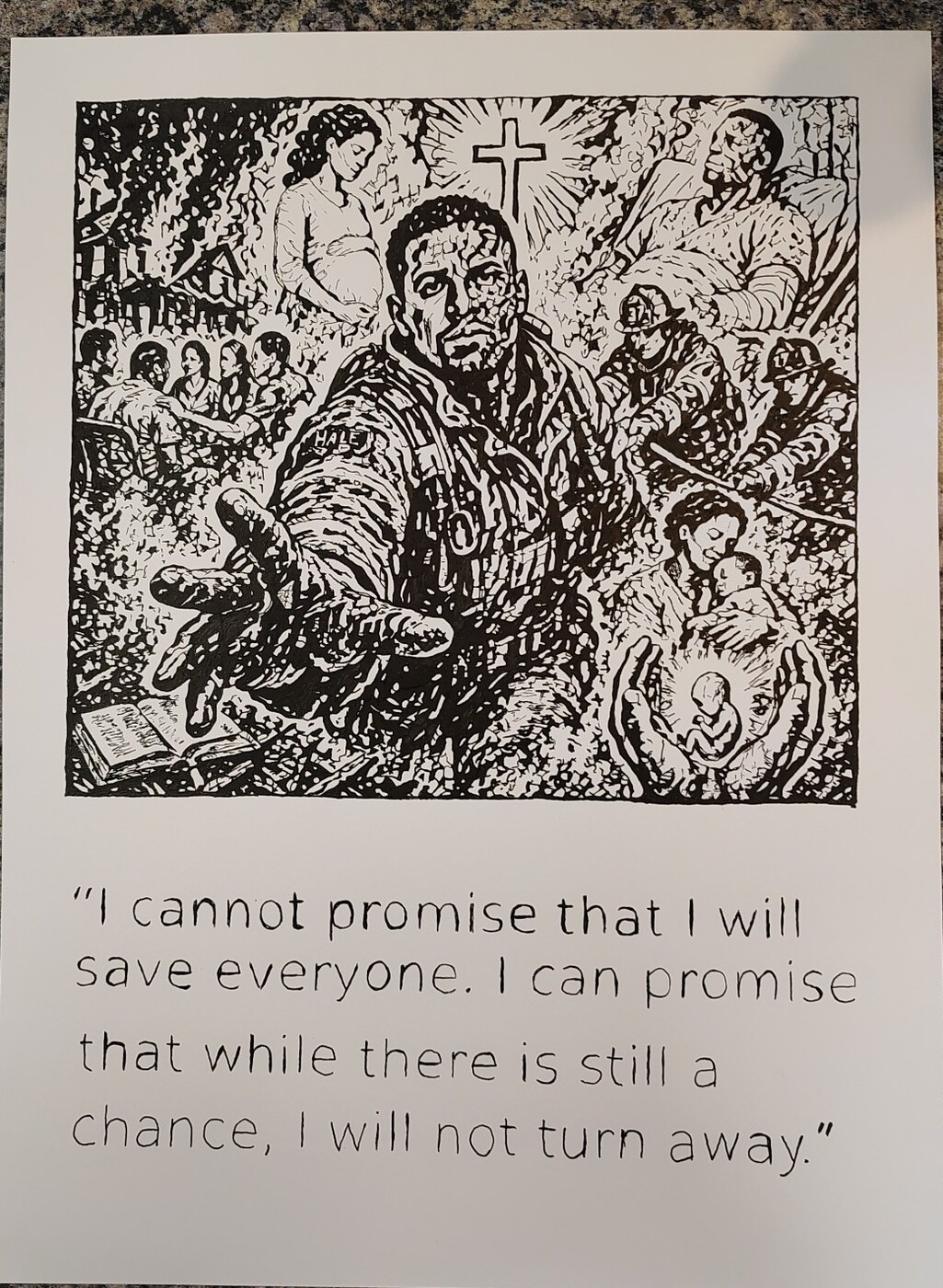
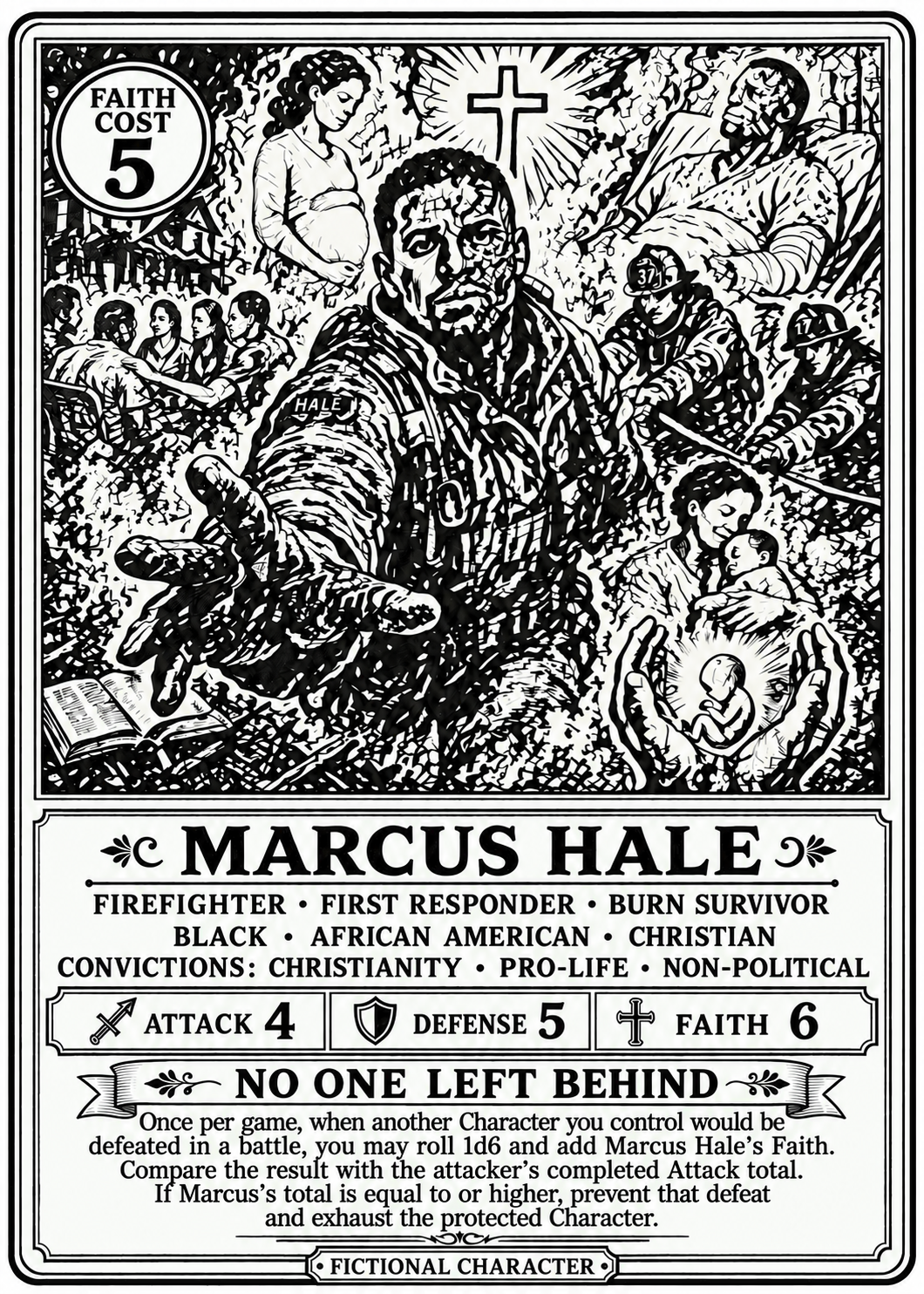
HOLY WARS ARTWORK · HAND-DRAWNMarcus Hale — original hand-drawn artwork by William Byrd. Holy Wars character art connects this research to the game; it is not a clinical illustration or evidence of medical fitness.
REAL-WORLD · EVIDENCE
05 Recovery, purpose & psychological change
There is no universal five-year pivot. Burn-survivor research describes differing trajectories of social participation, including work and employment, with some domains continuing to improve over many years. It does not establish a fixed year when a person becomes physically or psychologically ready for firefighting. [5]
Growth can coexist with distress. A VA study found reported post-traumatic growth among veterans who also reported PTSD symptoms. That supports coexistence, not a claim that everyone experiences a complete transformation. The study’s self-report and cross-sectional design limit conclusions about change over time or causation. [6]
A career choice does not establish a motive or diagnosis. Calling a person’s occupation “atonement” or “trauma reenactment” requires more than knowing their injury history and job. Such interpretations should be identified as hypotheses or authored character choices, rather than facts demonstrated by this research.
RESEARCH NOTES
06 Limits of the evidence
The exercise study examined a specific laboratory task; its findings do not establish performance in structural firefighting gear or medical eligibility for a particular department. Temperature sensitivity also varies between individuals.
The sources do not establish that willpower makes hazardous heat exposure safe, that returning to a similar environment is necessary for recovery, or that subsequent unsuccessful rescues inevitably cause deterioration or hallucinations. Specific temperature figures from a job-task description should not be treated as routine, safe targets.
The veteran study is not a burn-survivor occupational study. This dossier uses it only to explain the distinction between reported growth and the absence of distress. No clinical diagnosis or medical clearance is made here.
NFPA 1580 — Standard Development National Fire Protection Association · 2025 edition · Accessed October 24, 2026 Official standard overview · Consolidates NFPA 1581, 1582, 1583, and 1584
IAFF Guide to NFPA 1582 International Association of Fire Fighters · Hosted by IAFC · Guide to the 2013 edition · Historical reference Skin conditions and essential tasks · Not a substitute for the current adopted standard
High Rates of Post-Traumatic Growth among Veterans with PTSD U.S. Department of Veterans Affairs · Health Services Research · Publication brief for Tsai and colleagues, Psychological Medicine, January 2015 Study summary · Veteran sample; cross-sectional and self-reported
NFPA Standards Disclaimers National Fire Protection Association · Accessed October 24, 2026 Official explanation of NFPA’s role and enforcement limits
RESEARCH NOTES
08 Research record
Source check and website adaptation: October 24, 2026. Version 1.0. Adapted from William’s supplied burn-recovery research and the subsequent review, with AI-assisted source checking and editing. The entry covers real-world research; connections to fictional characters appear separately below.
Revision note: distinguished burned and grafted areas; updated the standards context; removed claims that willpower compensates for impaired cooling, that five years is a validated recovery interval, and that an occupational choice proves atonement or a particular diagnosis.
Follow the connection
Found In-Game
Explore each character or card, then follow its research tags back here.
Marcus’s established story includes burns, grafting, years of rehabilitation, and assessment before firefighter training. This research informs those requirements. His career choice is not proof of a diagnosis or atonement motive; the story’s private experiences remain fictional.