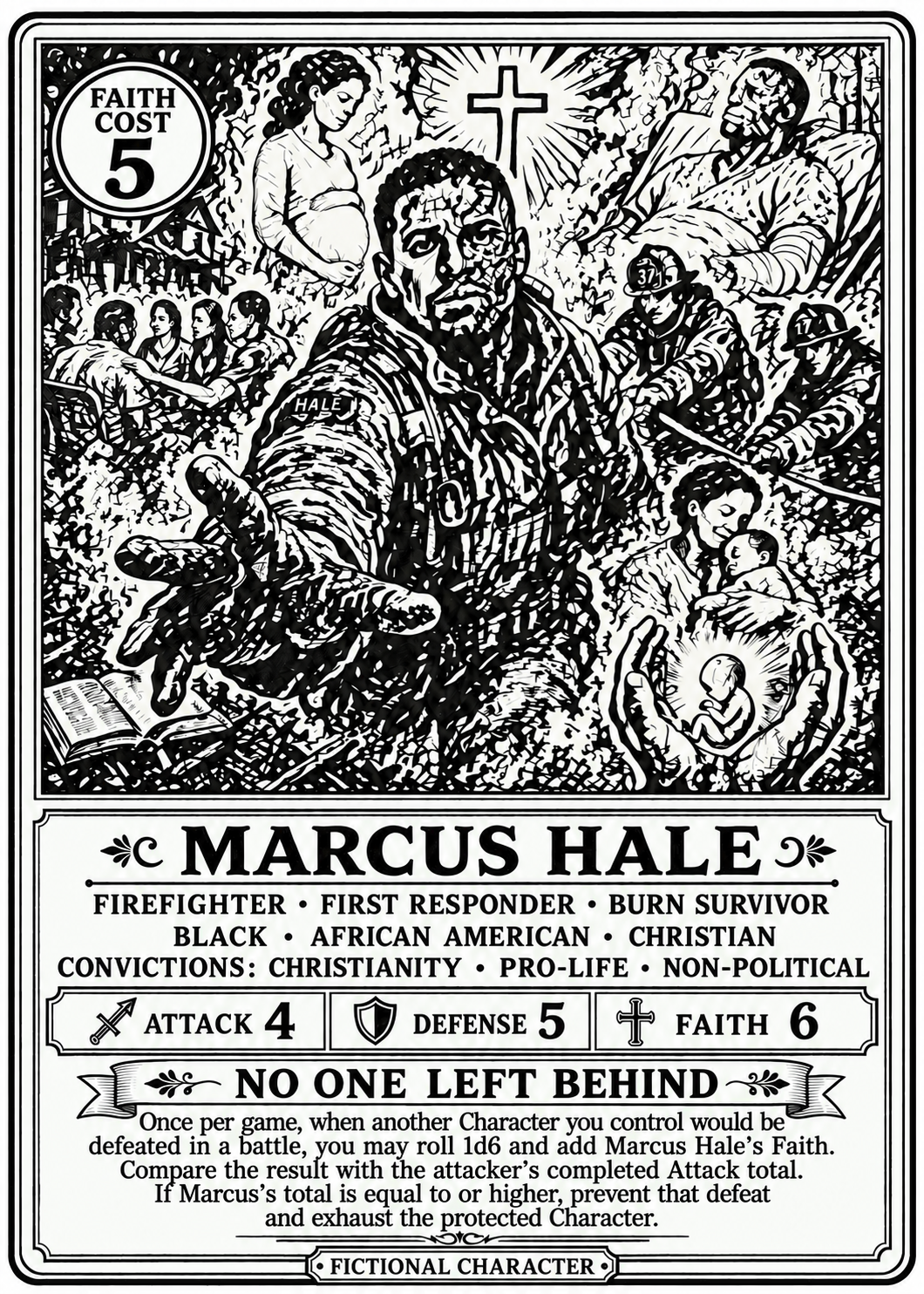
Marcus Hale
Character
His fictional grief, self-blame, and distressing perceptions connect to the trauma and bereavement research.
The research behind Marcus Hale’s grief, self-blame, and distressing perceptions—and the limits of explaining a fictional life through a diagnosis.
How can trauma, grief, and self-blame inform Marcus Hale without treating every bereavement experience as illness or assigning a diagnosis from a story?
Marcus’s fictional history combines catastrophic injury, the loss of his wife and unborn child, and later bereavement. Research offers context for his distress. It cannot determine the cause of every perception or establish the meaning of his private spiritual encounter.
Guilt and responsibility. The VA describes guilt, shame, and self-blame in moral injury, including distress about failing to prevent an event. Moral injury can overlap with PTSD but is not itself a psychiatric diagnosis. This is useful context for survival-related self-blame; it does not establish that Marcus was responsible for the loss. [1]
Experiences of the deceased. Elsaesser and colleagues surveyed 1,004 people reporting perceived contact with someone who had died. Experiences included a sensed presence and perceptions involving hearing, sight, or touch. Many participants found them meaningful or comforting. Such reports do not automatically indicate a disorder. [2]
A proposed perceptual model. Lyndon and Corlett discuss hallucinations reported in PTSD and propose a predictive-coding explanation involving the influence of prior expectations on perception. This is a theoretical account, not a proven explanation for every voice-hearing experience. Hallucinations are not a DSM-5 PTSD diagnostic criterion. [3]
PTSD and complex PTSD. ICD-11 distinguishes these diagnoses; complex PTSD includes additional difficulties with emotion regulation, self-concept, and relationships. The DSM does not recognize a separate complex PTSD diagnosis. Severe suffering alone is insufficient to assign that label to Marcus. [4]
The bereavement study used a purposive, self-selected sample of people reporting these experiences. It does not establish population prevalence, prove a supernatural explanation, or identify a single biological cause. [2]
An intrusive memory, a sleep-related perception, a sensed presence, and a hallucination are not interchangeable descriptions. A fictional scene cannot substitute for clinical assessment. This entry does not claim that grief “physically rewires” a particular person or that guilt necessarily produces an accusing voice.
In Marcus’s published companion story, The Story That No One Will Ever Know, his mother’s death reopens earlier grief. He hears Tessa’s voice, struggles with sleep, and withdraws from support. His case manager recognizes the need for further help rather than claiming certainty about the cause. These are fictional choices informed by research, not a clinical case report.
The accusing words, their timing, and Marcus’s private encounter are authored events. The published story leaves him uncertain whether the encounter was spiritual or arose from his distressed state. The dossier preserves that uncertainty and does not establish divine punishment, prophecy, a public following, or a medical diagnosis. Story spoilers: the linked companion story contains a mental-health crisis.
Source check and website adaptation: October 24, 2026. Version 1.0. Adapted from William’s supplied research batch, with source verification and AI-assisted editing. This is research for fictional characterization, not diagnostic guidance or a clinician’s review.
Revision note: removed unsupported claims that bereavement perceptions necessarily indicate a “broken” brain, that predictive coding is proven, and that complex PTSD is established for Marcus. Sources are credited to their authors and publishers; PMC is an archive.
Explore each character or card, then follow its research tags back here.
Character
His fictional grief, self-blame, and distressing perceptions connect to the trauma and bereavement research.