Firefighting: Duty, Physical Demands & Moral Injury
Fireground priorities, essential tools, candidate fitness testing, and the psychological distinction between traumatic stress and moral injury.
Source-checked adaptationUpdated October 24, 2026Version 1.0
Reality and fiction, clearly marked. Evidence sections describe the sources; game sections describe authored characters and events. Source-checked does not mean reviewed by a clinician or theologian. Read the evidence-status guide.
RESEARCH NOTES
01 Research question
What priorities and physical demands shape firefighting, and how can morally distressing experiences differ from, or overlap with, PTSD?
RESEARCH NOTES
02 Overview
This entry covers selected fire-service practices and psychological concepts. It distinguishes operational priorities, a standardized candidate test, and research on moral injury. It is an overview for readers and game development; actual procedures and employment requirements depend on the department and jurisdiction.
REAL-WORLD · EVIDENCE
03 Fireground priorities & tools
Three priorities. National Fire Academy materials identify life safety, incident stabilization, and property conservation. These guide decisions rather than defining three isolated phases. Life safety includes responders as well as civilians; actions that control a hazard can also protect life. [1]
The irons. A flat-head axe carried with a Halligan bar is commonly called a set of irons. The tools support forcible entry, but they are not a universal solution: training materials emphasize selecting tools appropriate to the structure and task. [2]
Overhaul. Overhaul involves finding and extinguishing remaining pockets of fire to prevent renewed burning. Tools may include pike poles, ceiling hooks, Halligan tools, and axes. Opening concealed spaces is part of locating hidden fire, rather than an indiscriminate destruction of walls and ceilings. [3]
REAL-WORLD · EVIDENCE
04 Physical demands & the CPAT
The IAFF/IAFC Candidate Physical Ability Test is a standardized, pass/fail assessment used by participating fire services. Its maximum completion time is 10 minutes, 20 seconds. Candidates wear a 50-pound vest, with an additional 25 pounds for the stair climb. [4]
The eight events cover stair climbing, hose dragging, carrying equipment, raising and extending a ladder, forcible entry, searching, a rescue drag, and a ceiling breach/pull task. Performance rules apply throughout. The test simulates selected job demands; passing it does not by itself establish every qualification for employment. [4]
The search event includes a dark obstacle environment. This illustrates why the role requires more than cardiovascular fitness. It does not establish that every fire produces complete sensory deprivation, deafness, or the same physiological workload. [4]
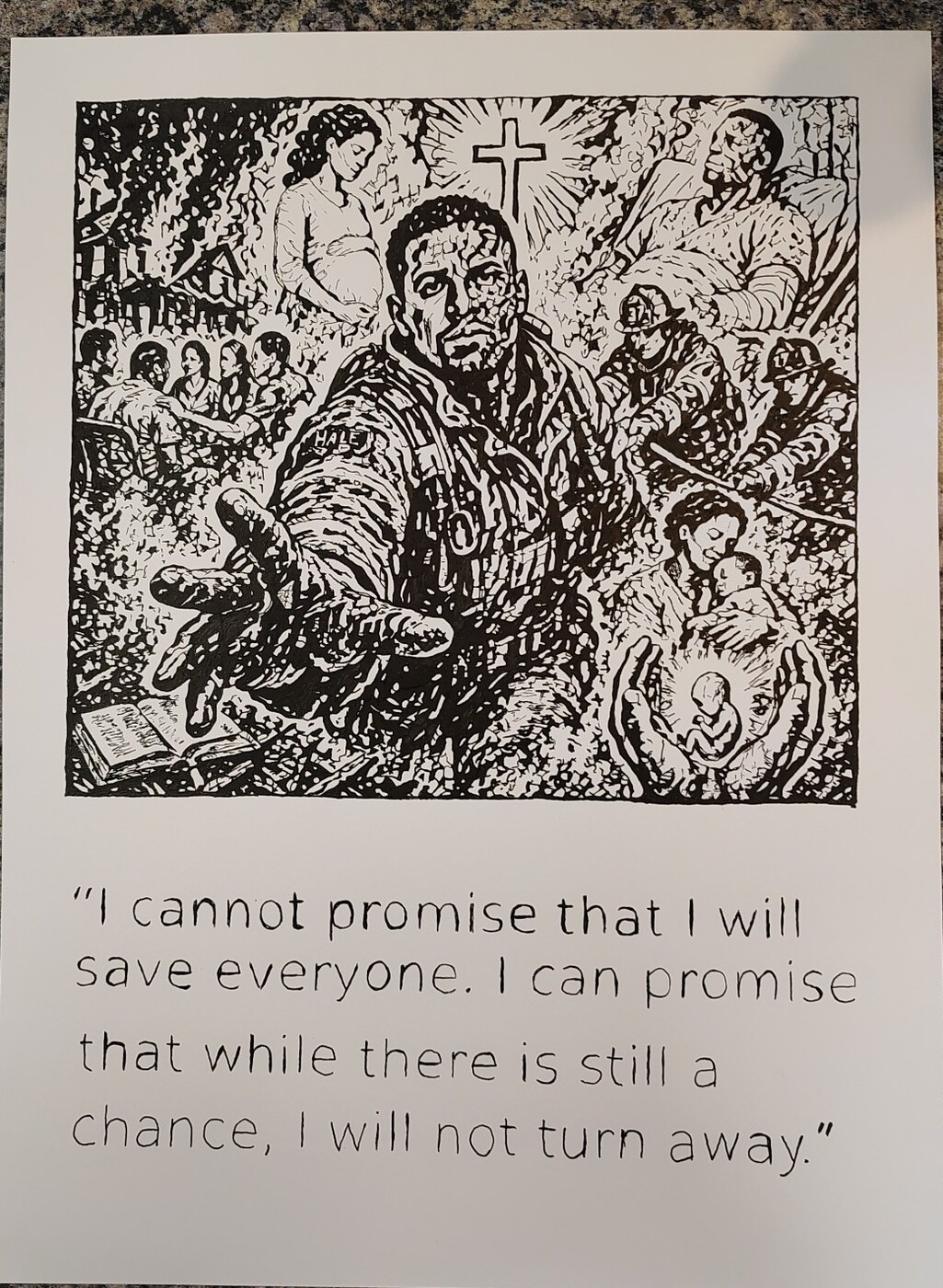
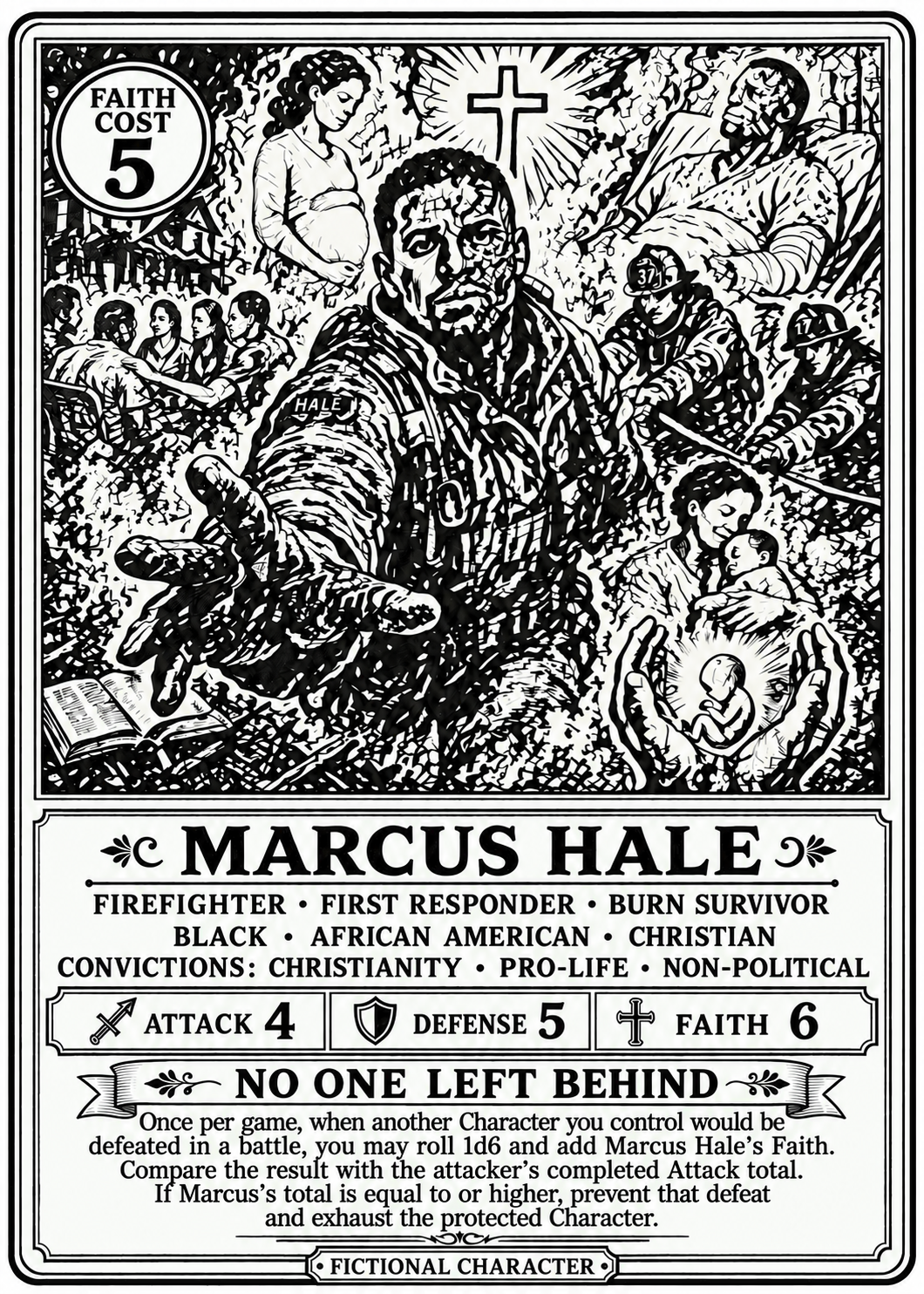
HOLY WARS ARTWORK · HAND-DRAWNMarcus Hale — original hand-drawn artwork by William Byrd. His rescue promise connects to the game’s themes of duty and care; this fictional scene is not an operational training diagram.
REAL-WORLD · EVIDENCE
05 Moral injury & PTSD
Potentially morally injurious events. Experiences involving a perceived violation of deeply held values—including an inability to prevent harm—can be morally distressing. Exposure does not automatically result in lasting moral injury, and perceived responsibility does not establish actual wrongdoing. [5]
Overlapping experiences. Moral injury can involve guilt, shame, anger, betrayal, loss of trust, or difficulty forgiving oneself. It is not itself a psychiatric diagnosis. PTSD can also include guilt, shame, and distrust; it cannot be reduced to fear alone. A person can experience both. [6]
RESEARCH NOTES
06 Evidence limits & interpretation
The VA sources draw substantially on military and veteran research. They are useful for understanding the concept of moral injury, but this entry does not use them to estimate its prevalence in firefighters or predict an individual responder’s outcome.
A rescue may hold personal meaning, but the supplied claims of a universal neurological “high” or temporary protection from accumulated trauma require specific supporting evidence and are not asserted here. Likewise, moral injury does not establish the cause of a person’s voice-hearing or other perceptions.
Fireground conditions, available resources, and hiring requirements vary. The CPAT is one defined assessment, not a universal account of every department’s recruitment process.
RESEARCH NOTES
07 Sources & further reading
Incident Safety Officer — Student Manual FEMA / U.S. Fire Administration / National Fire Academy · 4th edition, 3rd printing · February 2020 Training reference · Unit 3, Operational Scene Safety Analysis
CPAT: Development & Administration International Association of Fire Fighters · IAFF/IAFC program · Accessed October 24, 2026 Official test-program reference
Moral Injury U.S. Department of Veterans Affairs · National Center for PTSD · Accessed October 24, 2026 Clinical education · Includes limits of the evidence
Moral Injury and PTSD U.S. Department of Veterans Affairs · National Center for PTSD · Accessed October 24, 2026 Public clinical education · Overlap and differences
RESEARCH NOTES
08 Research record
Source check and website adaptation: October 24, 2026. Version 1.0. Adapted from William’s supplied firefighting research batch with AI-assisted verification and editing. This entry presents research; its game-world applications are kept in the separate connection panel below.
Revision note: corrected the CPAT time and stair-climb load, removed a rigid sequence for fireground priorities, distinguished moral injury from diagnosis, and removed unsupported claims about neurological rewards and the causes of hallucinations.
Follow the connection
Found In-Game
Explore each character or card, then follow its research tags back here.
His later firefighter training and rescue role connect to the physical and operational research. His “No One Left Behind” ability abstracts a rescue intervention. Marcus was a civilian during the original house fire; these links do not diagnose him or establish the cause of his perceptions.
How burn injuries and skin grafts can affect cooling, rehabilitation, and occupational assessment—with clear limits on what a recovery timeline or career choice can establish.