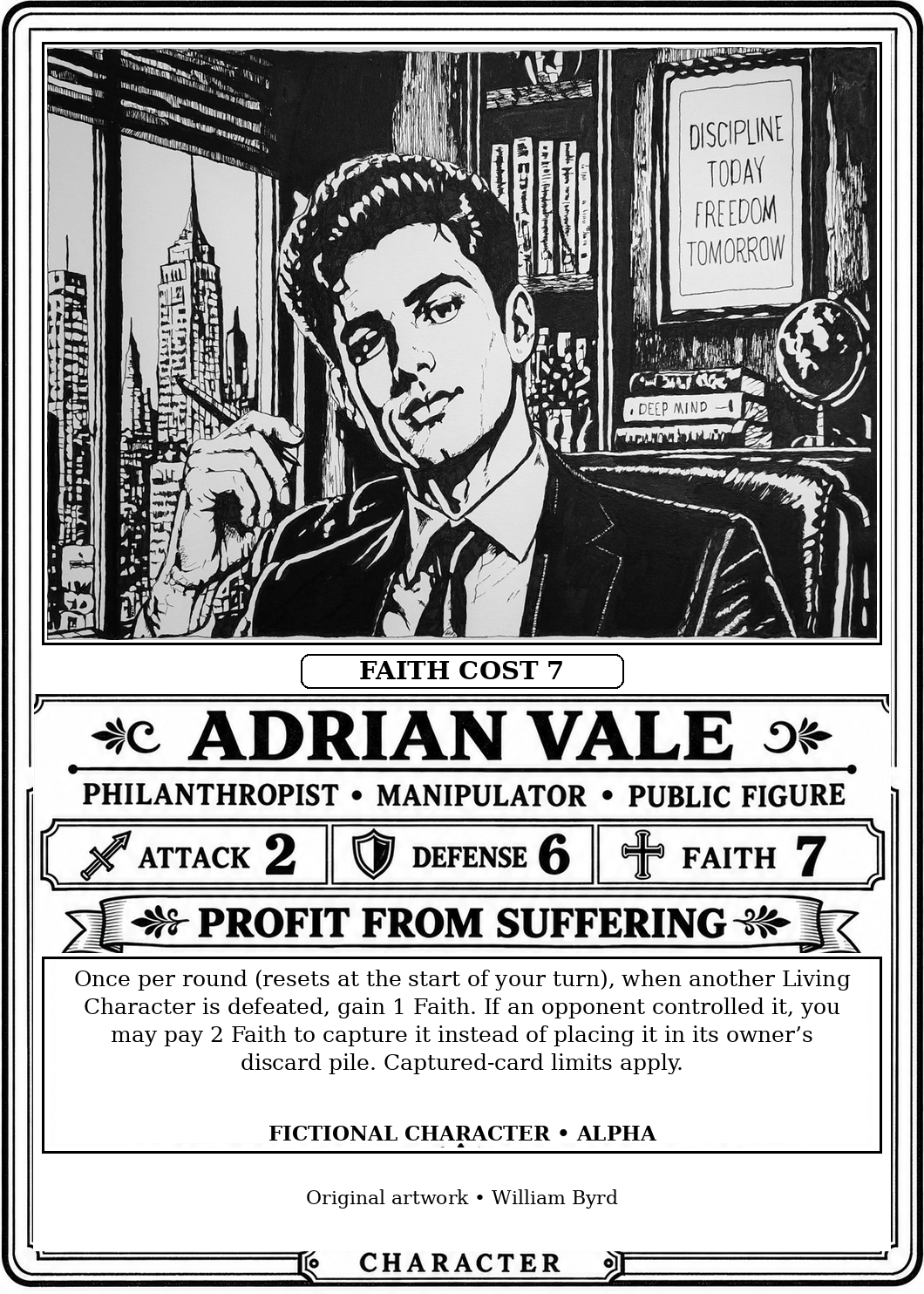
Adrian Vale
Character
Vale calls his scheme sustainability and treats suffering as an accounting variable. This is an authored rationalization, not proof that he feels no internal conflict.
A theory of how people justify rule-breaking, its original delinquency context, and the limits of applying it to other settings.
How can people justify rule-breaking, and what can a theory developed around delinquency contribute to interpreting a different setting?
Neutralization theory describes ways people may justify rule-breaking or reduce its conflict with their self-image. Whether and how these explanations apply depends on the individual and context. [1]
Sykes and Matza’s original paper presents a theoretical account of delinquency and the rationalizations associated with it. It should not be presented as a direct empirical study of contemporary corporate crime or philanthropy. [1]
Neutralization, compartmentalization, and cognitive dissonance are not interchangeable mechanisms. Systems thinking itself is not pathological and does not explain criminal conduct by itself.
Applying this theory to white-collar or organizational wrongdoing requires contextual interpretation and, for empirical claims, relevant supporting research. An explanation offered by a wrongdoer does not prove that guilt or inner conflict has disappeared.
Babiak and Hare’s book is additional contextual reading about organizational settings. No particular causal claim in this dossier relies on its title or book listing as empirical proof. [2]
Adapted from the reviewed Adrian Vale canonical master. Website adaptation: October 24, 2026. Version 1.0. The original theory’s scope is retained; fictional motivation is discussed separately.
Explore each character or card, then follow its research tags back here.
Character
Vale calls his scheme sustainability and treats suffering as an accounting variable. This is an authored rationalization, not proof that he feels no internal conflict.